
Berkeley Varitronics Octopus 4G LTE
4.6Editor score
Supports all US regional carriers
True RSRP RSRQ and RSSI measurements
No subscriptions or SIM cards required
Finding the right cellular signal meter for antenna aiming is crucial for installing boosters and improving connectivity. These devices provide real-time readings to ensure your antenna is perfectly aligned for maximum signal strength and reliability in any environment.
We evaluated ten top-rated meters based on frequency range, sensitivity, portability, and ease of use. Our comparison covers professional-grade tools and budget-friendly options designed for installers, technicians, and homeowners seeking reliable cellular performance.
Each pick highlights key features, pros, and cons to help you choose the best fit for your needs. Keep in mind that product availability and pricing may change over time, so verify details before purchasing your ideal signal meter today.
4.6Editor score

4.3Editor score

4.4Editor score
As an Amazon Associate we earn from qualifying purchases.
The following comparison table outlines the key specifications and features of each selected cellular signal meter to help you make an informed decision based on your specific antenna aiming and testing requirements.


The SureCall Five-Band RF Signal Meter is a highly rated tool designed for precise antenna aiming and booster installation. With a strong rating of 4.3 stars, it delivers reliable performance across multiple cellular bands including PCS, Cellular, AWS, and LTE frequencies. Its high sensitivity ensures that even weak signals are detected accurately during the alignment process.
We may earn a commission when you buy through this link, at no additional cost to you.
This device stands out due to its comprehensive band support covering 1930-1995 PCS, 869-894 Cellular, 2110-2155 AWS, and LTE ranges. The rechargeable design uses four AAA NiMH batteries which offer a working time of 2.5 to 3.5 hours. The controllable backlight is a thoughtful addition that allows for easy viewing in dark environments or at night during installation work.
While the meter offers excellent sensitivity at -110dBm, users should note that battery performance can vary based on how frequently the backlight is used. Additionally, the fixed band selection means it is optimized for specific US carriers and might not cover every global frequency standard. These trade-offs are generally acceptable given the device's focused purpose for booster setup.
Installers and technicians looking for a dedicated tool to optimize cell phone signal boosters will find this meter invaluable. It simplifies the aiming process by providing immediate feedback on signal strength across key bands. For anyone needing a reliable way to align antennas without complex equipment, this SureCall meter is a top recommendation.
By supporting five distinct bands including PCS and LTE this device ensures compatibility with most major network providers in the region.
The inclusion of rechargeable NiMH batteries reduces the need for constant replacements and keeps costs down over the long term.
We may earn a commission when you buy through this link, at no additional cost to you.
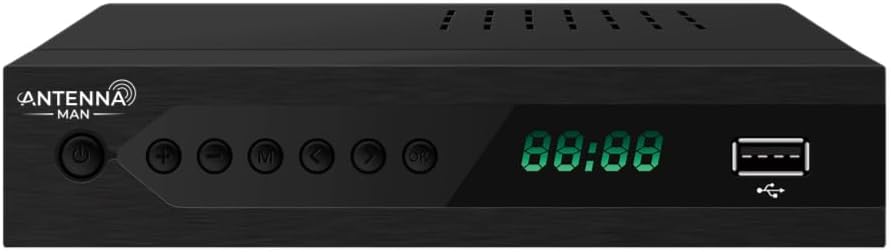
The Antenna Man Signal Meter offers a unique approach by combining signal metering with an ATSC digital converter box. While it has a moderate rating of 3.8 stars, it provides real-time signal strength information that is useful for aligning antennas. The device is marketed towards users who want to get more channels through better signal alignment.
We may earn a commission when you buy through this link, at no additional cost to you.
Its main advantage is the plug-and-play design which makes it accessible for users without technical expertise. The real-time signal strength feature allows for quick adjustments to antenna positioning. However, as a converter box focused on TV signals it may not provide the granular RF data needed for cellular booster installations.
The lower rating suggests that some users may have experienced limitations in sensitivity or features compared to dedicated RF meters. It is important to note that this device is primarily optimized for over-the-air TV reception rather than cellular frequencies. This distinction is critical when choosing the right tool for cellular aiming tasks.
For those needing a basic tool to improve TV antenna reception this meter serves its purpose well. It is less suitable for professional cellular signal aiming but remains a cost-effective solution for home entertainment setups. Users should verify their specific needs before purchasing to ensure compatibility with their intended application.
The plug-and-play nature of this device means no complex configuration is required to start checking signal strength immediately.
Unlike dedicated cellular meters this device is tailored for ATSC digital TV signals to help users maximize their channel count.
We may earn a commission when you buy through this link, at no additional cost to you.
The Berkeley Varitronics Octopus 4G LTE represents a premium choice for professionals working with EV charging stations and cellular boosters. With an exceptional rating of 4.6 stars, it offers true RSRP, RSRQ, and RSSI measurements that are critical for detailed network analysis. This tool is designed to support AT&T, Verizon, T-Mobile, and all regional carriers without requiring subscriptions or SIM cards.
We may earn a commission when you buy through this link, at no additional cost to you.
Its standout feature is the ability to deliver accurate 4G LTE measurements directly without additional software or phone dependencies. This independence makes it ideal for industrial sites where reliability is paramount. The device is also designed and manufactured in the U.S.A, ensuring quality control and support. It is particularly useful for alarm installs and utility telematics alongside booster setups.
While the performance is top-notch, the price reflects its professional-grade capabilities and specialized focus. It may be more advanced than a typical homeowner needs for simple antenna aiming. However, for installers who require precise data and carrier support across the board, the investment is justified by the accuracy and ease of use.
Professionals managing EV charging sites or deploying cell boosters will appreciate the precision this meter provides. It eliminates guesswork by offering industry-standard metrics for signal quality. If you need a robust tool for complex installations, this Octopus meter is an excellent premium option to consider.
The device supports major networks like AT&T Verizon and T-Mobile ensuring broad compatibility for various deployment scenarios.
No need for active subscriptions or apps means the device works standalone which is ideal for remote or industrial installations.
We may earn a commission when you buy through this link, at no additional cost to you.
The RF Explorer Pro Spectrum Analyzer is a powerful tool designed for engineers and RF professionals who need deep insight into signal environments. Although no rating is currently available, it offers an impressive frequency range from 15MHz to 6.1GHz. It combines spectrum analysis power measurement and tracking generator capabilities in a compact portable design.
We may earn a commission when you buy through this link, at no additional cost to you.
A key feature is the 8-inch high-definition touchscreen which provides clear real-time visualization of RF signals. Users can utilize advanced tools like Zero Span and 2D/3D Waterfall to analyze dynamic signals effectively. The internal battery supports up to 5 hours of operation making it suitable for extended field work without frequent recharging.
While it is versatile, the complexity of its features may be overwhelming for basic antenna aiming tasks. It is best suited for detailed interference analysis and cable diagnostics beyond simple signal strength checks. The lack of a public rating means users should review technical specifications thoroughly to ensure it matches their specific project needs.
Professionals working on complex RF environments will find this analyzer invaluable for troubleshooting and optimization. It bridges the gap between portable testers and lab-grade equipment. For those needing detailed spectrum analysis alongside basic aiming, this device offers a high level of functionality and portability.
The large touchscreen allows users to see detailed spectrum data which helps in identifying interference and optimizing antenna placement.
With up to 5 hours of battery life technicians can complete full site surveys without needing constant access to power sources.
We may earn a commission when you buy through this link, at no additional cost to you.
The NetAlly AirCheck G3 Pro Kit is designed for advanced network testing with a focus on Wi-Fi 6, 6E, and Bluetooth/BLE networks. While its primary function is Wi-Fi analysis, it includes a full tri-band spectrum analyzer and an external directional antenna. With a perfect rating of 5 stars, it indicates high satisfaction among users who need detailed network performance data.
We may earn a commission when you buy through this link, at no additional cost to you.
This kit features tri-band physical location detection which allows users to quickly find the location of access points and clients. It also supports site surveys with remote collaboration tools that save time on travel. The Link-Live platform consolidates field test data and integrates with network management systems for efficient centralized data management.
Although it is excellent for Wi-Fi, its suitability for cellular signal metering depends on the frequency bands supported. The included directional antenna helps with physical location but may not be optimized for cellular frequencies. Users should verify the frequency ranges against their cellular aiming requirements before relying on it for that purpose.
Network engineers and IT professionals looking for a robust tool to validate Wi-Fi performance will find this kit highly effective. It simplifies complex site surveys and troubleshooting through advanced data management. For cellular aiming, it is a powerful tool if frequency compatibility is confirmed.
AirMapper Site Survey enables remote engineers to collaborate with on-site technicians which reduces travel time and increases efficiency.
The ability to locate access points across three bands ensures precise identification of network devices for better management.
We may earn a commission when you buy through this link, at no additional cost to you.
The Extech 480836 RF EMF Strength Meter is a versatile tool for high frequency measurements ranging from 50MHz to 3.5GHz. With a rating of 4.3 stars, it is highly regarded for EMF measurements including mobile phones and base stations. Its non-directional isotropic probe ensures that signals are captured from all directions simultaneously.
We may earn a commission when you buy through this link, at no additional cost to you.
This meter is ideal for technicians who need to assess overall EMF levels rather than specific directional aiming. The manual store and recall feature allows users to save up to 99 sets of readings for later analysis. It is also suitable for detecting microwave leakage and other RF sources in various environments.
While it covers the cellular frequency range effectively, the non-directional nature of the probe means it cannot pinpoint directionality for antenna aiming. It is better suited for general safety checks and field assessments. Users looking for precise directional pointing should consider tools with directional antennas for better alignment results.
If you need a reliable meter for general RF environment assessment this Extech tool is a solid choice. It provides accurate EMF data without needing specialized directional equipment. For antenna aiming tasks that require directional feedback additional equipment may be needed to complement its measurements.
The triaxial probe ensures consistent results regardless of the meter orientation which is crucial for accurate EMF assessments.
Storing up to 99 sets of readings allows technicians to track changes over time without needing a connected computer.
We may earn a commission when you buy through this link, at no additional cost to you.
The MINI1300 Antenna Analyzer is a portable device designed for testing antenna SWR and frequency performance across HF VHF and UHF bands. With a rating of 4.4 stars, it offers a large 4.3-inch TFT LCD touching screen for clear interface navigation. Its frequency range extends from 0.1 to 1300MHz providing continuous coverage for various signals.
We may earn a commission when you buy through this link, at no additional cost to you.
Users can operate it in single point measurement scanning and TDR modes which adds versatility to its functionality. The device is compact and easy to carry making it convenient for field work. However, the firmware cannot be updated which means any feature improvements or bug fixes must be handled through hardware replacement or service.
The SWR measure range of 1.0 to 1999 allows for detailed impedance checks. While it is an excellent tool for general antenna tuning, the upper limit of 1300MHz may restrict some cellular aiming tasks depending on the carrier bands used. Careful review of specific cellular frequencies is recommended before relying solely on this device.
For technicians who need a compact analyzer for general antenna checks this MINI1300 is a great budget-friendly option. It is best used for optimizing antenna performance within its supported range. If your cellular bands fall within 1300MHz it can serve as a useful secondary tool for installation.
The 4.3-inch touching display makes it simple to adjust settings and view results without needing to use physical keys.
Having single point scanning and TDR modes provides flexibility for different types of antenna testing and troubleshooting.
We may earn a commission when you buy through this link, at no additional cost to you.
The SA6 6GHz Portable Spectrum Analyzer offers a 2-in-1 solution combining a spectrum analyzer and signal generator in one handheld device. It supports a broad frequency range from 35 to 6200MHz covering WiFi LTE and GSM signals. While no rating is available, the specifications suggest a versatile tool for both field and workshop use.
We may earn a commission when you buy through this link, at no additional cost to you.
Its 3.2-inch color touchscreen allows for real-time spectrum viewing and easy operation. The built-in tracking generator supports frequency response measurements which can be useful for filtering components. Weighing only 380g it is lightweight and easy to carry for on-site RF testing tasks. Battery life is approximately 3 to 4 hours depending on conditions.
The wide frequency range makes it a strong candidate for cellular aiming across multiple bands. However, the lack of a public rating means users should evaluate its accuracy and reliability carefully. The inclusion of a generator adds value but may not be necessary for simple aiming tasks.
Technicians needing a portable tool to check a variety of wireless signals will find this analyzer convenient. It is suitable for basic testing and debugging tasks in a compact package. For those who need both analysis and generation capabilities this SA6 model offers a balanced feature set.
The ability to generate signals helps in testing filters and amplifiers which adds value beyond simple signal detection.
At 380g this device is easy to carry in a pocket which is ideal for frequent field visits and inspections.
We may earn a commission when you buy through this link, at no additional cost to you.
The For Sa6 6GHz Handheld is a portable RF analyzer that covers frequencies from 35 to 6200MHz including WiFi LTE and GSM. With no available rating it presents itself as a rugged option for field and lab evaluation. It includes a tracking generator for characterizing filters and amplifiers which adds versatility to its function.
We may earn a commission when you buy through this link, at no additional cost to you.
This device offers a fixed 200 kHz resolution which is suitable for rapid RF environment assessment. It comes with a complete set of accessories including extension cables data cable and stylus. The compact 5.9 x 3 x 0.9 inch housing makes it energy efficient and easy to use in tight spaces or during maintenance work.
While the features are solid for its class, the lack of user feedback makes it a bit of a gamble compared to rated alternatives. The fast scan rates help in quick troubleshooting but may lack the depth of professional tools. Users should consider their tolerance for unverified products when choosing this model.
For technicians needing a small handheld tool for routine checks this analyzer offers good value. It is designed to be energy efficient and straightforward to operate. If you need a portable device for immediate RF evaluations this unit provides a decent feature set.
Scan rates up to 700 per second help technicians assess the RF environment quickly without lengthy setup times.
The inclusion of cables and a stylus means you have everything needed to start analyzing signals right out of the box.
We may earn a commission when you buy through this link, at no additional cost to you.
The Channel Master TV Antenna Signal Strength Meter is a digital handheld signal finder designed for precise OTA antenna alignment. With a rating of 3.9 stars it displays RF signal levels and SNR on a color touch-screen. It supports all over-the-air ATSC TV frequencies in the US making it a robust tool for TV antenna setup.
We may earn a commission when you buy through this link, at no additional cost to you.
The device includes a built-in rechargeable battery which ensures it can be used without constant power sources. It also comes with a stylus and a protective carrying case which adds value and convenience. The interface is user-friendly which helps in adjusting antenna direction until the signal is maximized for optimal reception.
While this meter is excellent for TV antennas it is not suitable for cellular signal aiming as it does not cover cellular frequencies. Users should be careful to distinguish between OTA and cellular requirements when choosing a meter. For home TV installations this device simplifies the process significantly.
For homeowners looking to install an OTA antenna this meter is a practical tool. It provides clear visual feedback for alignment and includes accessories to protect the device. If your goal is cellular signal optimization however you will need a device with different frequency capabilities.
The digital display shows both signal level and SNR which helps users optimize quality rather than just strength.
The included carrying case and stylus protect the device and make handling easier during outdoor alignment work.
We may earn a commission when you buy through this link, at no additional cost to you.
Selecting the right signal meter involves considering frequency compatibility ease of use and accuracy to ensure efficient antenna alignment and booster performance.
Ensure the meter supports the specific frequency bands used by your local carriers such as LTE AWS or PCS. Meters that cover a wide range of cellular frequencies will be more versatile and future-proof for various network setups.
Check the supported bands before buying to guarantee the device works with your intended carrier and booster system.
High sensitivity allows the meter to detect weak signals which is critical when aligning antennas in areas with low coverage. A device with a sensitivity of -110dBm or lower will provide accurate readings even in challenging environments.
Look for a high sensitivity rating to ensure precise aiming and reliable performance in remote locations.
For field work a compact and lightweight device is easier to carry and handle. Consider factors like battery life and whether the device includes a backlight for use in low light conditions.
Choose a portable unit with long battery life and ergonomic features to reduce fatigue during installations.
A user-friendly interface with clear displays and simple controls helps technicians work faster and with fewer errors. Touchscreens or intuitive menus can simplify the process of adjusting antenna positions.
Prioritize models with straightforward operation and readable displays to speed up your workflow.
Features like tracking generators data logging or support for multiple carriers can add value depending on your specific needs. Some meters offer SNR readings which provide more insight into signal quality beyond just strength.
Evaluate extra functionalities to see if they align with your professional or home requirements for detailed analysis.
Balance the cost of the meter with the features it offers. Professional tools are often more expensive but provide higher accuracy and durability compared to basic consumer models.
Invest in a meter that offers the best value for your specific use case to avoid overspending on unnecessary features.
For frequent use the device should be built to withstand rugged conditions and physical impacts. A sturdy casing and quality components will ensure longevity and reliability in the field.
Select a durable model that can handle daily use and harsh weather without compromising performance.
If you work with multiple carriers choose a meter that supports a broad network of providers. Universal support ensures you can service different customers without needing multiple devices.
Opt for a device with wide carrier compatibility to increase your service versatility and efficiency.
To use the meter effectively connect it to your antenna or signal source and power it on. Navigate through the menu to select the correct frequency band that matches your carrier's signal. This ensures that the device focuses on the right data for accurate readings.
Hold the device steady near the antenna feed point and rotate the antenna slowly while observing the signal strength indicator. When the reading peaks you have found the optimal direction. Record the position to fine-tune alignment for the strongest signal possible.
Maintain the device by keeping the screen clean and storing it in its protective case when not in use. Regularly charge the battery and check for firmware updates to ensure continued accuracy. Proper care will extend the life of your meter and keep it ready for future installations.
Look for bands that cover your specific carrier's LTE PCS AWS or Cellular frequencies. A meter that supports multiple bands allows you to test different networks without needing several devices. Ensure the device covers 1900MHz and 800MHz to 900MHz ranges for broad US coverage.
No a TV signal meter is tuned to ATSC frequencies which are different from cellular networks. Using one for cellular aiming will not provide valid results. It is important to select a meter that specifically supports cellular and LTE bands.
A good meter should have sensitivity at or below -110dBm to detect weak signals accurately. This level of sensitivity ensures you can see small changes when adjusting antenna direction. Higher sensitivity helps in maximizing performance in areas with poor reception.
Most dedicated cellular signal meters do not require a SIM card as they measure RF energy directly. Some advanced tools like smartphones apps may require a SIM to read network data. Verify the device requirements before purchasing to avoid compatibility issues.
Calibration usually involves following the manufacturer's instructions to reset or adjust readings against a known signal source. Some devices have automatic calibration features. Check the manual for specific steps to ensure your device remains accurate over time.
Battery life typically ranges from 3 to 5 hours depending on usage and features like backlighting. Rechargeable models offer convenience for long installations. Carry a spare power source if you expect to work through multiple tasks.
Many meters are designed for field use but check for water resistance ratings. For extreme weather conditions consider protective cases or models designed for rugged environments. Always protect the device from rain and dust when installing antennas outdoors.
SNR stands for Signal to Noise Ratio and higher values indicate cleaner signal quality. While signal strength is important SNR affects data speeds and reliability. Aim for higher SNR values to ensure stable connections after alignment.
We reviewed ten top cellular signal meters ranging from professional tools to budget-friendly options. The SureCall Five-Band RF Signal Meter stands out as an excellent all-around choice for booster installations.
Prioritize frequency compatibility sensitivity and portability when making your decision. Select a device that matches your carrier and installation needs to ensure the most accurate and efficient results.
Always check current availability and specifications before purchasing as product details may change. With the right meter you can confidently optimize your antenna setup for better connectivity.