
Synology 16 bay RackStation RS4021xs+
4.7Editor score
8-Core Intel Processor
Up to 234k Random Read IOPS
Two PCIe Expansion Slots
Dual Redundant Power Supplies
Selecting the right storage solution is critical for professionals and enterprises managing vast amounts of data. A 16 Bay NAS Enclosure offers the perfect balance of capacity and performance for growing needs.
We evaluated ten top models based on connectivity, expansion capabilities, build quality, and compatibility. Our analysis ensures you find a unit that meets your specific technical requirements efficiently.
Each pick highlights key strengths and potential trade-offs to guide your decision. Note that availability and specifications may change, so verify details before purchasing to ensure satisfaction.
4.7Editor score
4.5Editor score

4.5Editor score
As an Amazon Associate we earn from qualifying purchases.
This side-by-side comparison highlights the critical differences between the top contenders. From processing power to expansion options, review these specs to identify the ideal unit.


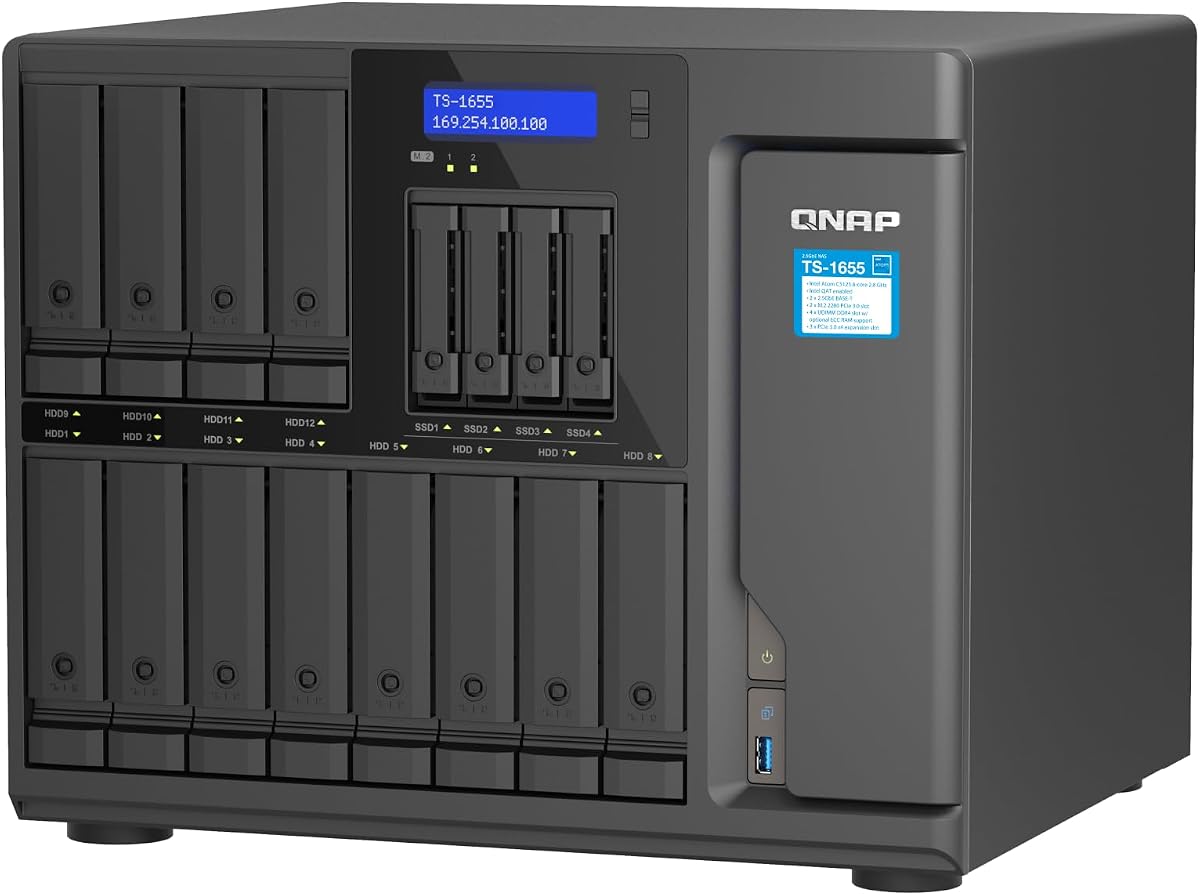
The QNAP TS-1655-8G-US stands out as a robust solution for hybrid storage needs. With a solid rating and versatile connectivity, it is designed for users requiring both capacity and speed.
We may earn a commission when you buy through this link, at no additional cost to you.
Its Intel Atom C-5125 8C processor handles intensive tasks like virtualization and backup restoration effectively. The dual 2.5GbE RJ45 ports ensure that file access remains fast even during large data transfers.
While the unit is powerful, it is not without trade-offs. The noise levels can be higher than passive models, which might not suit home offices. However, for professional environments, the performance justifies the noise.
This NAS is ideal for small to medium businesses needing reliable storage scaling. If you require a unit that balances cost with high-end features like ECC RAM support, this model is a top recommendation.
Support for ECC RAM ensures that data corruption is minimized during critical operations, providing peace of mind for mission-critical tasks.
The inclusion of dual 2.5GbE ports allows for link aggregation and faster throughput compared to standard gigabit solutions.
We may earn a commission when you buy through this link, at no additional cost to you.
The Synology RS4021xs+ is a premium rackmount option designed for businesses that cannot afford downtime. It delivers high-performance computing alongside massive storage capabilities.
We may earn a commission when you buy through this link, at no additional cost to you.
With an 8-core Intel processor, it can host multiple compute-intensive services efficiently. The dual redundant power supplies are a critical feature for ensuring that your data remains accessible at all times.
While the price point is high, the performance and reliability justify the investment for enterprise users. The expansion capabilities allow you to scale up to 40 drive bays seamlessly.
This model is best for organizations needing top-tier reliability and speed. If your budget allows for high-end gear, the RS4021xs+ offers a powerful and scalable solution for your infrastructure.
Dual redundant power supplies ensure that if one fails, the system remains online, preventing data loss during power fluctuations.
Using two RX1217(RP) units allows you to expand your storage to up to 40 drive bays, accommodating massive data growth.
We may earn a commission when you buy through this link, at no additional cost to you.
The QNAP TL-D1600S is an excellent choice for users looking to expand their existing storage without upgrading their entire NAS system. It serves as a powerful expansion unit.
We may earn a commission when you buy through this link, at no additional cost to you.
It includes a high-performance PCIe SATA interface card that ensures fast data transfer rates. The enclosure supports a mix of 3.5-inch and 2.5-inch drives, offering flexibility in drive selection.
Since it is a JBOD enclosure, it relies on your host computer for management. This might be a limitation for some users, but it keeps costs down while providing raw capacity.
This unit is perfect for desktop workstations or servers needing extra space. If you already have a reliable NAS or server, adding this enclosure is a cost-effective way to boost your storage.
The enclosure is designed to work seamlessly with QNAP NAS and other computers, making it easy to add capacity instantly.
Supporting both 3.5-inch and 2.5-inch drives allows you to use existing hardware or mix drive types for optimal density.
We may earn a commission when you buy through this link, at no additional cost to you.
The CENMATE Aluminum 12 Bay Enclosure is a direct-attached storage option for users who need fast access to multiple drives without complex network setup.
We may earn a commission when you buy through this link, at no additional cost to you.
Its USB 3.0 interface offers transfer speeds up to 5Gbps, making it suitable for media editing or quick backups. The aluminum build ensures durability and heat dissipation.
While the fans keep drives cool, they can generate noise around 40-50 decibels. Users sensitive to noise should consider placement carefully. Always load drives one by one to ensure proper recognition.
This enclosure is a strong choice for individuals needing expandable external storage. If you want a simple plug-and-play solution that can chain to other devices, this model fits the bill well.
Three built-in cooling fans prevent overheating during heavy usage, protecting your data and extending drive lifespan.
The daisy chain feature allows you to connect multiple units, expanding your total storage to up to 720TB.
We may earn a commission when you buy through this link, at no additional cost to you.
The Synology DX1222 is designed to extend the life and capacity of your existing Synology DiskStation. It provides a straightforward way to add storage without migrating data.
We may earn a commission when you buy through this link, at no additional cost to you.
Setup is quick using Synology DSM's unified tools, allowing you to configure new storage in minutes. The unit is diskless, giving you the flexibility to choose your preferred drives.
While it is an expensive addition, the ease of integration and reliability make it a favorite for Synology users. It is essential to check compatibility with your specific DiskStation model before purchase.
This expansion unit is ideal for Synology owners needing more space. If you want to avoid the hassle of complex RAID setups and just want more room, this is a reliable choice.
Configuring the expansion is seamless within the existing Synology DiskStation Manager interface, maintaining a single administrative point.
Adding drives via this unit is straightforward, ensuring that your NAS grows as your needs expand without downtime.
We may earn a commission when you buy through this link, at no additional cost to you.
The ZhenLoong Full Tower Case is a robust chassis for enthusiasts building their own NAS from scratch. It supports a wide range of motherboard form factors and drive types.
We may earn a commission when you buy through this link, at no additional cost to you.
With 15 hot-swap bays and redundant PSU support, it is built for serious performance and reliability. The case is designed to accommodate both ITX and EEB boards, offering great flexibility.
One downside is the long shipping cycle of up to 40 days. Also, as a generic product, support documentation is limited compared to branded solutions. However, the raw hardware quality is impressive.
This case is best for DIY builders needing a high-capacity server chassis. If you are comfortable assembling components and waiting for shipping, it offers a cost-effective path to a powerful custom NAS.
Supporting ITX, MATX, ATX, and EATX boards allows you to tailor the internal hardware exactly to your project needs.
Features like redundant power support and SATA3 backplanes bring enterprise features to home-built storage systems.
We may earn a commission when you buy through this link, at no additional cost to you.
The Asustor Lockerstor 10 Gen3 is a powerhouse built for enthusiasts and small businesses needing extreme speed. It pairs strong AMD hardware with cutting-edge networking interfaces.
We may earn a commission when you buy through this link, at no additional cost to you.
Its dual 10GbE ports and USB4 40Gbps connections ensure that data moves as fast as your drives can handle. ECC DDR5 RAM provides stability for virtualization and heavy multitasking.
While it only has 10 bays, the performance per bay is exceptional. The inclusion of enterprise features like ECC memory ensures that data remains accurate during intensive operations.
This NAS is ideal for creative studios or IT environments needing speed. If you need to move large files quickly and want modern connectivity standards, this model is a top contender.
USB4 and 10GbE ports future-proof your storage setup, allowing for rapid data transfers without bottlenecks.
ECC RAM helps prevent data corruption, which is critical when handling large databases or virtual machines.
We may earn a commission when you buy through this link, at no additional cost to you.
The Synology DS3622xs+ is a high-end DiskStation designed to handle enterprise workloads. It combines a powerful processor with expandable options for growing data needs.
We may earn a commission when you buy through this link, at no additional cost to you.
With over 260,000 IOPS, it excels at handling virtual machines and heavy file access. The ability to scale up to 36 bays makes it a future-proof investment for large offices.
While the base price is high, the versatility of the platform offsets it for many businesses. However, for small setups, the cost of expansion units can add up quickly.
This model suits businesses needing a robust server. If you need to host backups and video management systems on a single reliable platform, the DS3622xs+ is a strong option.
The 6-core Xeon processor supports multiple VMs efficiently, making it a central hub for your digital assets.
Support for 25GbE networking ensures your NAS is not the bottleneck in a high-speed network environment.
We may earn a commission when you buy through this link, at no additional cost to you.
The QNAP TL-R1600PES-RP-US is a compact rackmount solution for businesses needing to expand storage in limited spaces. Its short depth design makes it ideal for small media cabinets.
We may earn a commission when you buy through this link, at no additional cost to you.
With 16 drive bays and redundant power supplies, it ensures continuous operation even during power failures. The Mini-SAS HD interface connects directly to compatible QNAP units for easy management.
While the rail kit is sold separately, the enclosure itself is robust and well-designed for enterprise use. It is a reliable way to add petabyte-level storage capacity to your existing setup.
This unit is perfect for IT departments managing rack space. If you need a simple and reliable expansion that fits tightly in your rack, this QNAP JBOD is an excellent choice.
The short depth design allows you to fit this enclosure in cabinets that would normally be too shallow for standard rackmount units.
Redundant power supplies ensure that your storage remains online even if one power source fails, minimizing downtime.
We may earn a commission when you buy through this link, at no additional cost to you.
The QNAP TS-1655 High Performance NAS offers a balanced approach for users needing stable, long-term support. It is designed with business continuity and consistent performance in mind.
We may earn a commission when you buy through this link, at no additional cost to you.
Its Intel Atom 8-core processor provides ample power for multimedia transfer and virtualization. The long-term availability promise means you can rely on this model for years without immediate obsolescence.
While it may not have the highest specs on the market, its reliability makes it a solid choice for budget-conscious enterprises. The dual 2.5GbE ports ensure that file access remains smooth.
This NAS is ideal for businesses planning long-term infrastructure. If you value consistent performance and support over raw speed, this model provides a dependable foundation for your data.
Long-term availability ensures that you can plan your storage strategy without worrying about the model being discontinued soon.
Dual 2.5GbE ports allow for faster file access and backups compared to standard 1GbE connections.
We may earn a commission when you buy through this link, at no additional cost to you.
Choosing a 16 Bay NAS Enclosure requires careful consideration of your data needs, budget, and infrastructure. This guide breaks down the key factors to help you make an informed decision.
The interface speed determines how fast your data can move in and out of the storage. Look for units with USB 3.0, Thunderbolt, or high-speed Ethernet like 10GbE to avoid bottlenecks during large file transfers. Ensure your existing network or PC has the necessary ports to support these speeds.
Prioritize units with modern interfaces like USB-C or 2.5GbE to future-proof your setup.
For tasks like virtualization, video transcoding, or running multiple apps, a powerful processor is essential. Check the core count and clock speed to ensure the unit can handle your specific workload. RAM capacity is also crucial for smooth multitasking and caching; look for models that allow upgrades.
Choose a unit with expandable RAM if you plan to run multiple services or handle large datasets.
With 16 drives running simultaneously, heat management is critical. Units with multiple fans or optimized airflow designs keep temperatures down. However, active cooling can be noisy, so check the decibel levels if the device will be in a home office or quiet space.
Consider fanless or low-noise models for quiet environments, or ensure your device stays in a utility area.
As your data grows, you may need more than 16 bays. Look for units that support daisy-chaining or additional expansion units. Check compatibility with add-on drive enclosures to ensure you can scale up without replacing your entire system.
Verify compatibility with expansion units before buying to avoid future compatibility issues.
The enclosure material affects durability and heat dissipation. Aluminum or steel casings are generally more robust than plastic. Also, consider whether the unit includes redundant power supplies, which are vital for continuous operation in business environments.
Select units with solid materials and redundant power features for better reliability.
If the unit is a full NAS, the operating system determines usability and feature set. Synology and QNAP offer intuitive interfaces with rich app ecosystems. For JBOD enclosures, ensure compatibility with your current OS like Windows or Linux for seamless integration.
Test software features and OS compatibility to ensure it fits your workflow.
A strong warranty indicates manufacturer confidence and protects your investment. Look for units with at least a 2-year warranty, with many enterprise models offering 5 years. Check the availability of customer support channels and technical documentation.
Opt for models with long warranties and reliable support for peace of mind.
Hot-swappable bays allow you to replace drives without shutting down the system. This feature is essential for minimizing downtime during drive maintenance or upgrades. Ensure that your selected unit supports this functionality clearly before purchasing.
Ensure the enclosure supports hot-swap to allow drive changes while the system is running.
Start by installing your hard drives one by one to ensure proper detection. Most units recommend powering on the system after each drive is inserted to verify integrity before adding the next.
Keep the enclosure in a well-ventilated area to prevent overheating. Regularly check that fans are spinning and dust is cleared from vents to maintain efficient cooling and extend drive lifespan.
Schedule regular firmware updates to ensure security and performance. Use the provided management tools to monitor drive health and run diagnostics periodically to catch issues early.
Most 16 Bay Enclosures are designed as DAS or JBOD units that require a host system to function. Some models like the Synology or QNAP NAS offer standalone functionality with their own operating system. Always check if the unit includes an internal processor or requires external connectivity.
These enclosures typically support 3.5-inch and 2.5-inch SATA drives. Some models also support M.2 NVMe SSDs for caching or storage. Always verify the specific drive size and interface supported by your chosen unit before buying.
Most NAS Enclosures are sold as diskless units, meaning you must purchase the drives separately. This allows you to choose the capacity and brand that best fits your budget and performance needs. Verify the diskless status in the product details.
Connection depends on the interface. USB 3.0 models connect directly to your PC, while rackmount or network models use Ethernet. For USB units, use the provided cable to link to a free port on your system.
Yes, but consider noise and space requirements. Large enclosures often run fans that can be loud. If you need high capacity for media or backups, these units work well in utility rooms or dedicated spaces.
Capacity depends on the drive size you choose. Some models support up to 20TB per drive, totaling over 300TB or more. Check the maximum supported drive size per bay to calculate your total potential capacity.
Many units support daisy-chaining or adding expansion enclosures. For example, some models allow adding extra units to triple the total storage. Always check for daisy-chain or expansion support in the product specs.
Some NAS units support built-in RAID for data redundancy. DAS models may rely on your host system for RAID setup. If hardware RAID is important, look for units with built-in controllers or software RAID options.
We reviewed ten top contenders ranging from budget DAS options to high-end enterprise NAS systems. Each offers unique strengths depending on whether you prioritize speed, capacity, or reliability for your workflow.
Focus on the features that matter most to your setup, such as cooling performance, network speed, or expansion options. Ensuring compatibility with your current hardware is key to avoiding unnecessary upgrades.
Remember that availability and specifications can change over time. Check current stock and verify the latest details with the manufacturer before making your final purchase decision.