
Entina Tina2C
4.4Editor score
STEM learning modules
App and WiFi control
Compact mini design
This guide compares the top 3D printers for educational use, featuring models optimized for STEM learning, safety, ease of use, and classroom reliability in
Choosing the right 3D printer for educational use requires balancing safety, ease of operation, and learning potential. Schools and homes need machines that inspire creativity while ensuring reliable performance for students of all ages.
We evaluated ten leading models based on safety certifications, setup time, software accessibility, and educational resources. Each printer was assessed for its ability to support STEM curricula and facilitate hands-on learning experiences without technical frustration.
Every pick in this list highlights key strengths for classrooms or home labs. While prices and availability change, these models represent the most reliable options for fostering innovation and technical skills through 3D printing technology.
4.4Editor score

4.7Editor score

4.6Editor score
The following table provides a side-by-side comparison of all ten educational 3D printers, highlighting their key specifications and standout features to help you make an informed decision for your learning environment.





The Bambu Lab A1 stands out as the top choice for educational settings due to its fully automatic calibration and high-speed precision. With a rating of 4.7, it delivers exceptional accuracy while minimizing manual setup time, making it ideal for classrooms where efficiency matters.
We may earn a commission when you buy through this link, at no additional cost to you.
Key strengths include its 10,000 mm/s² acceleration and active flow rate compensation, ensuring smooth prints every time. The full-auto calibration handles Z-offset and bed-leveling automatically, so students focus on creativity rather than technical adjustments. Its quiet operation and simplified touchscreen further enhance the user experience for beginners.
While the AMS lite multi-color module is an additional purchase, the base printer remains highly capable for single-color educational projects. The requirement for a stable Wi-Fi connection may limit use in areas with poor connectivity, but offline options are available for core functions.
Educators seeking a reliable, low-maintenance printer for STEM labs will find the A1 exceptional. It balances performance and ease of use, ensuring students achieve consistent results while learning design principles.
The A1 handles all calibration processes automatically, including Z-offset and bed-leveling, removing barriers for novice users and ensuring optimal performance on every print.
With active motor noise canceling and blazing-fast printing speeds, the A1 maintains a quiet environment while delivering high-detail prints efficiently.
We may earn a commission when you buy through this link, at no additional cost to you.
The Entina Tina2C is designed specifically for first-time users and kids, offering a fully assembled mini 3D printer that starts printing in just 8 minutes. With a rating of 4.4, it provides an accessible entry point into STEM education through guided setup and interactive tools.
We may earn a commission when you buy through this link, at no additional cost to you.
Its Poloprint Cloud app enables AI-powered search, photo-to-print features, and access to 3000+ models alongside 20+ creative DIY modules. The compact 3.9-inch print volume suits small projects and classroom desks, while WiFi and offline printing flexibility adapts to different workflows.
The small build size limits larger projects, and full functionality depends on app connectivity. However, its self-cleaning nozzle and power-loss recovery reduce downtime, ensuring a frustration-free experience for young learners focused on creativity.
For parents or educators on a budget seeking a kid-friendly 3D printer, the Tina2C delivers value through its ready-to-use design and educational resources that turn screen time into hands-on learning.
The Tina2C offers guided setup through its app, allowing users to start their first print in as little as 8 minutes without technical frustration.
Regularly updated STEM courses and interactive modules transform the printer into an engaging educational tool for families and classrooms.
We may earn a commission when you buy through this link, at no additional cost to you.
The Ugee Funbox redefines educational 3D printing with its UL GREENGUARD certified safety, zero-calibration setup, and access to over 12,000 curated toys and models. Its 4.6 rating reflects a premium experience designed to inspire creativity while ensuring safety for young users.
We may earn a commission when you buy through this link, at no additional cost to you.
Features include a 500mm/s peak print speed, built-in HD camera for time-lapse videos, and AI engines that turn drawings or text into printable models instantly. The fully enclosed body with anti-pinch doors and HEPA filtration provides peace of mind in any environment.
Though limited to single-color PLA printing, kids can build multi-color models by assembling separate parts, fostering fine motor skills and planning abilities. The higher price is justified by its comprehensive safety certifications and extensive educational content library.
For households or schools seeking a top-tier, safe, and engaging 3D printer, the Funbox offers unmatched educational value through its AI tools, vast model library, and child-friendly design.
Certified to UL GREENGUARD Gold standards, the Funbox ensures non-toxic materials and low emissions, keeping air quality safe for children.
Four AI engines convert photos, voice, or text into printable 3D models instantly, enabling kids to create without prior design skills.
We may earn a commission when you buy through this link, at no additional cost to you.
The Bambu Lab P1S is a ready-to-use FDM printer with a fully enclosed body that supports advanced filaments like ABS and ASA. Its 4.5 rating highlights reliable performance and quick 15-minute setup, ideal for classrooms moving beyond basic PLA projects.
We may earn a commission when you buy through this link, at no additional cost to you.
With speeds up to 500mm/s and support for 16-color printing via the optional AMS, the P1S enables complex, multi-material projects. Auto bed leveling and user-friendly design ensure consistent results without manual intervention.
The enclosed design may require ventilation in smaller rooms, and the AMS accessory is a separate cost for multi-color capabilities. However, its capability to handle engineering filaments expands educational possibilities significantly.
Educators aiming to introduce students to a broader range of materials and multi-color printing will find the P1S a powerful, versatile choice for advanced STEM curricula.
The fully enclosed body improves print performance for advanced filaments, making it suitable for engineering materials like ABS and ASA.
Setup takes just 15 minutes, with auto bed leveling ensuring high-quality prints right out of the box for all skill levels.
We may earn a commission when you buy through this link, at no additional cost to you.
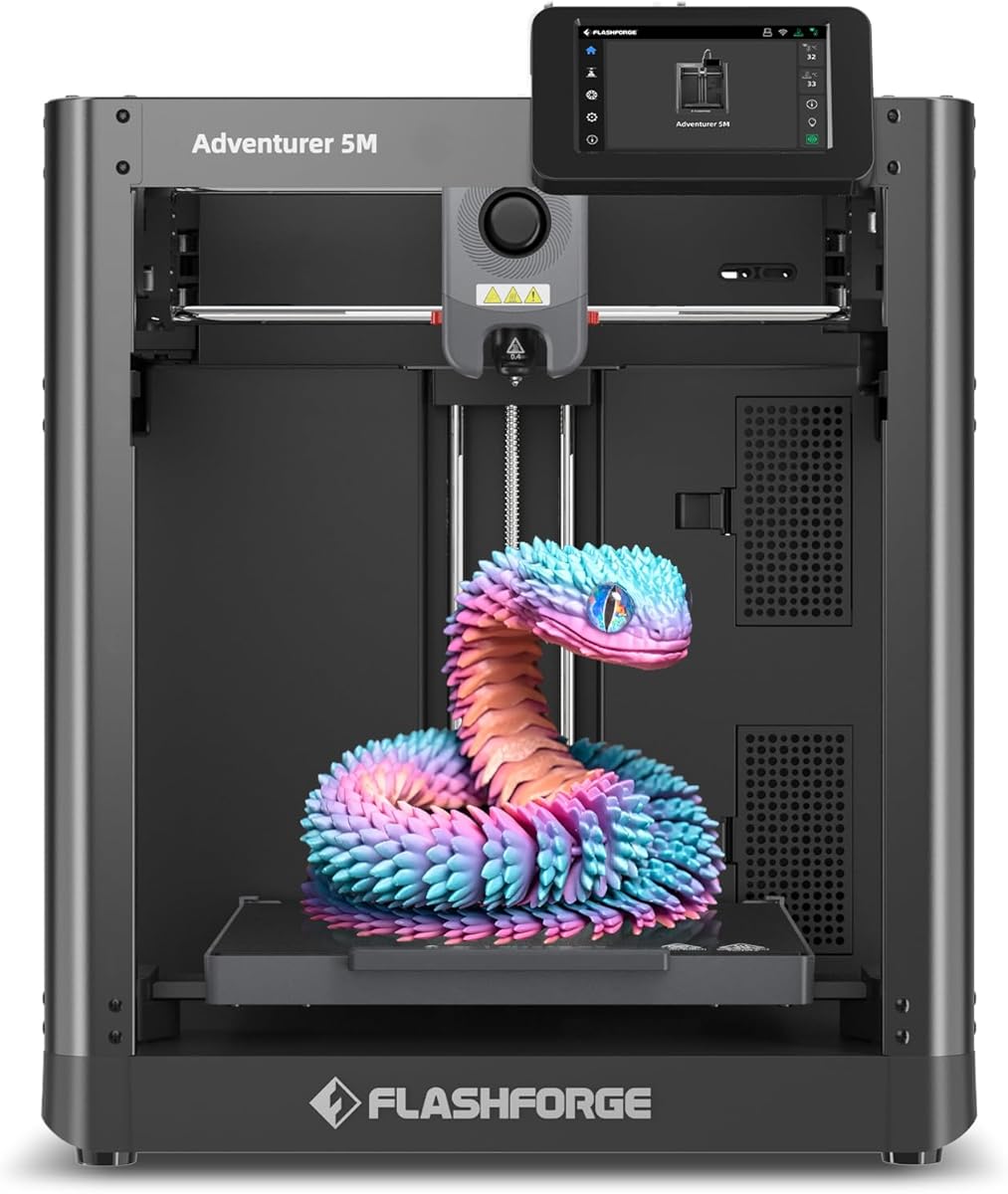
The FLASHFORGE Adventurer 5M offers a high-speed CoreXY structure capable of 600mm/s travel speeds, making it ideal for rapid prototyping. With a 3.9 rating, it emphasizes efficiency and automation, featuring automatic bed leveling and real-time app monitoring for remote management.
We may earn a commission when you buy through this link, at no additional cost to you.
Its 280°C direct extruder and 3-second nozzle changes support versatility, while dual-sided PEI platforms ensure easy model removal. The dual-fan cooling and vibration compensation maintain quality even at high speeds.
Some users may find the high-speed focus requires more careful calibration to achieve perfection, and the rating suggests room for improvement in reliability. However, the one-click setup reduces manual adjustments significantly.
For tech-savvy educators wanting fast results and remote monitoring, the Adventurer 5M delivers efficiency, though it requires attention to ensure consistent print quality in educational settings.
With 600mm/s speed and 20,000mm/s² acceleration, the AD5M maximizes efficiency, reducing production cycles for student projects.
The Flash Studio app allows remote monitoring and status alerts, ensuring a seamless experience for instructors managing multiple devices.
We may earn a commission when you buy through this link, at no additional cost to you.
The FLASHFORGE AD5M combines automatic one-click leveling with a patented quick-release nozzle system, allowing 3-second swaps for different diameters. Its 4.3 rating reflects strong build quality and ease of maintenance, perfect for classrooms needing minimal downtime.
We may earn a commission when you buy through this link, at no additional cost to you.
CoreXY all-metal motion ensures stable, low-noise performance at high speeds, while Orca-flashforge slicer enables network monitoring. Power-loss recovery and double-sided PEI plates add reliability and ease of use.
The printer requires manual filament loading, and network features depend on connected infrastructure. However, its resilient design and fast tool changes streamline operations for busy educational environments.
Educators prioritizing durability and fast maintenance will appreciate the AD5M's reliable performance, making it a solid middle-ground option for technical projects.
Nozzles can be swapped in as little as 3 seconds without tools, simplifying maintenance for novices and experts alike.
The printer saves the ongoing layer and resumes automatically when power is restored, preventing wasted time and material.
We may earn a commission when you buy through this link, at no additional cost to you.
The Bambu Lab A1 Mini Combo delivers the speed and calibration benefits of the A1 in a compact package with AMS lite included for multi-color printing. Its 4.2 rating highlights accessibility and ease of use, perfect for smaller classrooms or home labs.
We may earn a commission when you buy through this link, at no additional cost to you.
Features include 10,000 mm/s² acceleration, full auto calibration, and active flow rate compensation for smooth prints. The 20-minute setup and pre-assembled design reduce barriers to entry, while the compact size suits limited spaces.
The smaller build volume restricts large projects, but its color capabilities enable detailed educational models. While the rating is slightly lower than the standard A1, it remains a strong contender for color-focused learning.
For schools needing a space-efficient printer with built-in multi-color support, the A1 Mini Combo offers an excellent balance of performance and practicality.
The A1 Mini brings vibrant multi-color printing to smaller spaces with AMS lite included for reliable, accessible creativity.
Pre-assembled with 20-minute setup, it handles calibration automatically to ensure optimal performance for every print.
We may earn a commission when you buy through this link, at no additional cost to you.
The Snapmaker U1 features a 4-toolhead system with 5-second tool changes, enabling true multi-color and multi-material printing without manual swaps. With a 4.5 rating, it serves advanced users who want to explore complex assemblies and engineering materials.
We may earn a commission when you buy through this link, at no additional cost to you.
Its CoreXY system reaches 500mm/s, supports rigid and flexible materials in one print, and includes automatic calibration. The built-in model library and Orca slicer simplify workflows, while remote app control adds flexibility.
The complexity of managing multiple toolheads may overwhelm beginners, and the cost is higher than entry-level options. However, its efficiency reduces waste and expands design possibilities significantly.
For advanced workshops or universities, the U1 offers unmatched multi-material capabilities, preparing students for professional-grade 3D printing environments.
SnapSwap system reduces tool change time from 2 minutes to 5 seconds, minimizing waste and maximizing productivity.
Combine rigid and flexible materials or soluble supports in a single print for functional and complex prototypes.
We may earn a commission when you buy through this link, at no additional cost to you.
This Adventurer 5M variant offers similar high-speed performance with full auto one-click leveling and vibration compensation to eliminate ghosting. Its 4.3 rating highlights its robust design and filament run-out sensor, ensuring reliable prints in open environments.
We may earn a commission when you buy through this link, at no additional cost to you.
The CoreXY structure achieves 600mm/s speeds with 20,000mm/s² acceleration, while 35-second warm-up reduces wait times. Flexible PEI plates and power-loss recovery add practicality for continuous learning sessions.
As an open design, it requires good ventilation for safety, limiting use in tightly sealed rooms. However, its durability and speed make it suitable for well-ventilated classrooms.
Educators needing a fast, reliable printer at a competitive price will find this variant a valuable asset for rapid prototyping and project-based learning.
Full auto one-click leveling calibrates the bed properly to ensure accurate and smooth surfaces for quality performance.
The printer detects empty spools and pauses, allowing users to change filament and resume without losing progress.
We may earn a commission when you buy through this link, at no additional cost to you.
The Bambu Lab P2S Combo includes AMS 2 Pro for seamless multi-color printing, featuring PMSM Servo Extruder and active flowrate compensation. With a 4.7 rating, it delivers professional-grade quality suitable for high-end educational workshops and advanced design courses.
We may earn a commission when you buy through this link, at no additional cost to you.
Adaptive airflow maintains optimal chamber temperatures for different filaments, while built-in drying keeps spools ready. Quick-swap nozzles and AI failure detection ensure smooth workflows, and MakerWorld integration provides access to over a million models.
The high cost may exceed budgets for basic classrooms, and some advanced features may go unused. However, its capability to print engineering materials with color fidelity is unmatched.
For institutions aiming to replicate professional 3D printing workflows, the P2S Combo offers the performance and tools needed to inspire the next generation of engineers.
The AMS 2 Pro enables seamless multi-color/multi-material printing with built-in filament drying for flawless results.
Adaptive airflow automatically balances cooling and heat retention for crisp overhangs and stable engineering prints.
We may earn a commission when you buy through this link, at no additional cost to you.
Selecting the right 3D printer for educational use involves evaluating safety, setup complexity, material support, and learning resources. This guide outlines the critical factors to ensure your choice supports meaningful STEM instruction.
Safety is paramount when students operate 3D printers in classrooms or homes. Look for models with UL GREENGUARD certification or similar standards that ensure low emissions and non-toxic materials. Enclosed designs with anti-pinch doors protect users from hot surfaces and moving parts, making supervision easier for educators and parents.
Prioritize printers with safety certifications to protect students and ensure compliance with school regulations.
Educational 3D printers should minimize technical hurdles that distract from learning objectives. Models with fully automatic calibration handle bed-leveling and Z-offset adjustments without manual tools, allowing students to start printing within minutes. Pre-assembled units reduce frustration and increase accessibility for beginners.
Choose printers that start printing quickly with automatic setup to maximize teaching time and minimize technical delays.
Software integration is critical for STEM curricula. Look for printers compatible with intuitive slicing software and platforms offering model libraries, guided projects, or AI-powered design tools. Features like remote monitoring and app control enable instructors to manage multiple printers efficiently and support remote learning environments.
Ensure the printer's software ecosystem supports teaching goals with accessible design tools and classroom management features.
Beyond PLA, some educational settings require printers capable of handling PETG, TPU, or engineering filaments like ABS for functional prototypes. Enclosed chambers help maintain temperature stability for advanced materials. Understanding the filament range supported helps educators design diverse projects that challenge students creatively.
Select a printer that supports the materials needed for your curriculum to expand project possibilities.
Build volume determines the size of printable models, while speed affects project completion time. For classroom environments, faster printers reduce downtime between assignments, and moderate build sizes suit most educational designs. High speeds can be educational, but reliability should not be sacrificed.
Balance speed and build size to match project requirements without compromising print quality.
Compact, quiet printers fit better in classrooms and home offices without disrupting other activities. Look for noise-canceling features and small footprints to maximize space efficiency. This ensures the printer can remain in shared learning spaces without causing distractions.
Prioritize low-noise, compact models to ensure seamless integration into learning environments.
Educational printers must run reliably to maintain student engagement. Features like power-loss recovery, filament run-out sensors, and quick-swap nozzles reduce downtime. Durable, all-metal structures often offer better longevity for frequent use in busy settings.
Choose models with built-in reliability features to minimize interruptions and maintenance effort.
Access to active user communities, tutorials, and responsive customer support enhances the educational experience. Printers backed by robust documentation and online model libraries empower educators to troubleshoot issues quickly and access endless project ideas.
Consider the strength of community support and resources to ensure long-term usability and learning growth.
Begin by placing the printer in a well-ventilated area away from direct sunlight and heat sources. Connect it to a stable power supply and Wi-Fi network if applicable, ensuring the environment remains safe for all users during operation.
For optimal results, keep the build plate clean and calibrated regularly. Use the auto-leveling feature as needed and ensure nozzles are clear before each print session to avoid clogs or print failures that waste material.
Perform routine maintenance by inspecting belts, motors, and cooling fans for dust accumulation. Clean the exterior with a soft cloth, avoid harsh chemicals, and store unused filament in dry, airtight containers to preserve print quality over time.
The Ugee Funbox stands out for its UL GREENGUARD certification, enclosed body, and HEPA filtration, ensuring non-toxic emissions and physical safety for children. These features make it a top choice for educational environments prioritizing student health and well-being.
Many models like the Bambu Lab A1 and Entina Tina2C offer fully automatic calibration and user-friendly apps that minimize manual adjustments. These features enable students and educators to start printing within minutes without technical expertise.
Yes, several options such as the Bambu Lab A1, P1S, P2S Combo, and Snapmaker U1 support multi-color printing via optional or included AMS modules. These tools allow students to create vibrant, detailed models in a single print job.
Most educational printers, including the Bambu Lab P1S and Ugee Funbox, can be set up in under 20 minutes. Some even arrive pre-calibrated and assembled, allowing users to begin printing almost immediately after unboxing.
Absolutely. Models like the Entina Tina2C and Ugee Funbox include dedicated STEM modules, guided courses, and extensive model libraries designed to align with educational curricula and foster hands-on learning experiences.
Most printers support PLA and PETG, while advanced models like the P1S and P2S Combo also handle TPU, ABS, and ASA. Always check the manufacturer's filament recommendations to avoid clogging or quality issues.
Many educational models feature noise-canceling technology, operating at below 48 dB, which is quieter than normal conversation. This ensures minimal disruption in classrooms or home offices during operation.
Several printers, including the FLASHFORGE AD5M and Adventurer 5M, include power-loss recovery features that save the current print layer and resume automatically when power is restored, preventing wasted time and materials.
The Bambu Lab A1, Entina Tina2C, and Ugee Funbox lead our list for their unmatched balance of ease of use, safety, and educational features. These models empower students to focus on creativity and design while minimizing technical barriers.
When selecting a 3D printer for education, prioritize models with automatic calibration, safety certifications, and strong software support. These features ensure reliable performance and meaningful learning experiences for students at all skill levels.
Remember that prices and availability can change, so always verify current details before purchasing. With the right 3D printer, educators can inspire the next generation of innovators through hands-on STEM learning.