
2pcs AHT30 High Precision Digital Temperature and Humidity Sensor
5.0Editor score
Cost effective solution
Fast transmission speed
Low power consumption
This comprehensive guide compares the top Arduino temperature sensor modules available in October 2026 to help you choose the right hardware for your specific
Selecting the right sensor is crucial for any Arduino project involving environmental monitoring. A good temperature sensor provides accurate readings, easy integration, and reliability across various conditions.
We evaluated ten leading options based on accuracy, communication protocols, waterproof capabilities, and ease of use. This list covers digital sensors, waterproof probes, and humidity combinations.
Each pick highlights specific strengths and ideal use cases to simplify your decision process. Please note that availability and stock levels may change frequently over time.
5.0Editor score

4.7Editor score

4.9Editor score
The following table provides a side by side comparison of the technical specifications and key attributes for all ten reviewed temperature sensor modules.




The Teyleten Robot SHT31 module stands out as the top choice for precision and versatility. It combines excellent accuracy with a flexible I2C interface for seamless Arduino connectivity.
We may earn a commission when you buy through this link, at no additional cost to you.
Its wide voltage range and robust humidity measurement capabilities make it suitable for both indoor and outdoor environmental monitoring projects without compromising data integrity.
While the price is higher than basic resistive sensors, the improved accuracy and digital output reduce calibration efforts and provide more reliable long term results.
Buyers seeking a premium solution for climate control or scientific data collection will find this module offers the best balance of performance and reliability.
This module delivers precise readings with tight tolerances ensuring your project data remains accurate over extended periods.
Operating on voltages from 2.4 to 5.5 volts allows compatibility with various battery and logic levels.
We may earn a commission when you buy through this link, at no additional cost to you.
This sensor offers an unbeatable value proposition for budget conscious makers and students. It provides high precision measurements while keeping the total project cost minimal.
We may earn a commission when you buy through this link, at no additional cost to you.
The upgraded digital output ensures stable data transmission with low power draw which is ideal for battery powered remote monitoring applications.
While it lacks waterproofing and higher temperature ranges, its performance in standard indoor conditions is excellent for most hobbyist automation tasks.
It is the ideal pick for beginners looking to integrate temperature and humidity sensing without breaking the bank on components.
Achieve high accuracy measurements without the high cost typically associated with precision environmental sensor modules.
Low power consumption ensures your device lasts longer on limited energy sources like AA batteries or coin cells.
We may earn a commission when you buy through this link, at no additional cost to you.
This kit is specifically designed for harsh environments where moisture resistance is non-negotiable. The stainless steel probes ensure durability against corrosion and physical impact.
We may earn a commission when you buy through this link, at no additional cost to you.
The inclusion of adapter boards simplifies wiring by providing a built-in pull up resistor for the one wire protocol used by the DS18B20 sensor.
It supports a wide temperature range making it perfect for industrial monitoring or outdoor weather stations where conditions vary drastically.
Enthusiasts needing reliable long term monitoring in wet or corrosive environments will appreciate the robust build quality of this kit.
Stainless steel casing and sealed connectors allow continuous submersion in water or exposure to harsh industrial conditions.
Adapter boards include necessary components to connect directly to GPIO pins without extra soldering or loose resistors.
We may earn a commission when you buy through this link, at no additional cost to you.
This pack offers five identical modules allowing for distributed sensing in large rooms without needing to buy single units later. The pre-calibrated digital output reduces setup time significantly.
We may earn a commission when you buy through this link, at no additional cost to you.
While the accuracy is lower than newer models, it remains sufficient for general room monitoring and educational projects where absolute precision is not critical.
The single-wire scheme minimizes component count and simplifies the physical layout of your project breadboard or PCB design.
It is an excellent entry-level option for classrooms or bulk projects where multiple nodes are required at a low total cost.
Five units in one package allow you to deploy multiple sensors across different areas immediately without ordering more.
The integrated bypass capacitor and pull-up resistor make board level integration straightforward for beginners.
We may earn a commission when you buy through this link, at no additional cost to you.
The one meter lead length is a standout feature that allows placing sensors in hard to reach areas without extending wires manually. This is highly useful for measuring inside enclosures or tanks.
We may earn a commission when you buy through this link, at no additional cost to you.
The adapter module simplifies connections and provides necessary pull up resistors ensuring a stable signal over the longer wire distance used.
While slightly more expensive than bare probes, the convenience of the extra length and included adapter saves time and soldering effort during setup.
Users needing to monitor remote points within a larger system will find the extended lead length invaluable for flexible deployment.
Extra long wires enable sensing in confined or hazardous spaces without exposing the main controller electronics.
The adapter module ensures signal integrity over longer cable runs by managing electrical noise and resistance.
We may earn a commission when you buy through this link, at no additional cost to you.
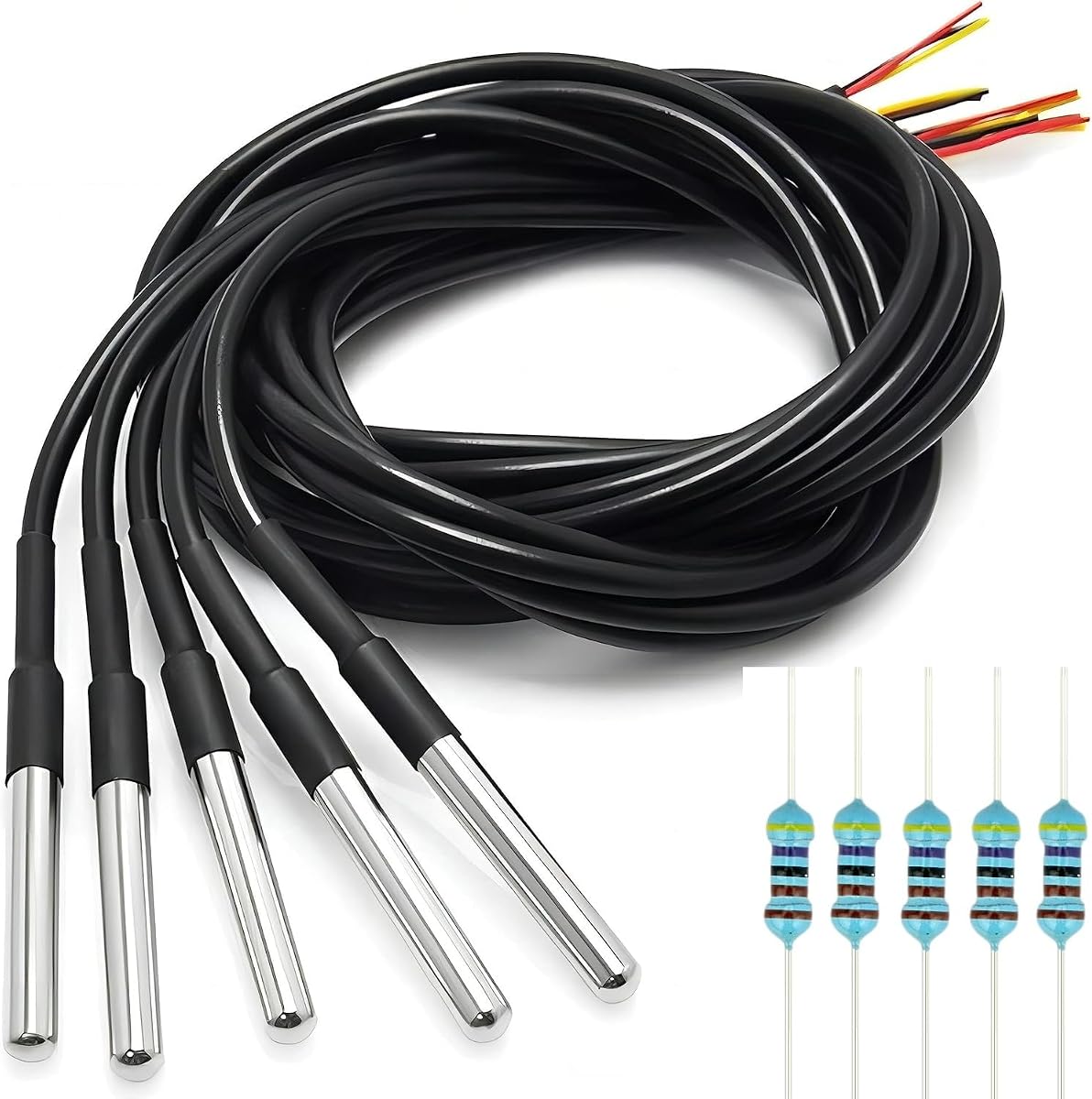
This kit stands out by including the required pull up resistors in the package ensuring you have every component needed to start immediately. It simplifies the bill of materials significantly.
We may earn a commission when you buy through this link, at no additional cost to you.
The waterproof probes are suitable for wet environments and the wide voltage range ensures they work with various logic levels found in modern microcontrollers.
While the resistors are loose components requiring manual insertion, having them included prevents the frustration of waiting for a specific resistor value to arrive.
It is a practical choice for DIYers who want a complete solution for multi-point temperature sensing without hunting for additional small components.
Every essential component including resistors is included to minimize delays in starting your project.
Supports multiple microcontroller platforms making it adaptable for various existing project architectures.
We may earn a commission when you buy through this link, at no additional cost to you.
This module is designed for simplicity and ease of use making it a staple for introductory electronics courses. The digital output eliminates the need for analog reading logic.
We may earn a commission when you buy through this link, at no additional cost to you.
It features high reliability and long term stability which ensures consistent readings even after extended periods of continuous operation in static environments.
The low cost allows users to replace units if damaged without impacting the project budget significantly and keeps learning materials affordable.
Beginners learning the basics of sensor interfacing will find this model forgiving and straightforward to integrate into basic code examples.
Simple wiring and protocol allow students to focus on coding and logic rather than complex hardware configuration.
Long term stability ensures that calibration does not drift significantly over time in controlled environments.
We may earn a commission when you buy through this link, at no additional cost to you.
Offering five sensors with one meter leads this package is ideal for monitoring multiple locations with minimal wiring complexity. The single bus interface allows daisy chaining easily.
We may earn a commission when you buy through this link, at no additional cost to you.
The waterproof design ensures you can measure liquid temperatures or outdoor air without worrying about moisture damage affecting the reading accuracy.
While a manual resistor is required for the data line this is standard for the protocol and does not significantly increase assembly difficulty.
This pack is perfect for large scale environmental monitoring where cost efficiency across many nodes is a primary concern.
Multiple sensors on one wire allow easy expansion of your monitoring points without consuming more microcontroller pins.
Suitable for industrial control consumer products and any thermally sensitive system needing remote monitoring.
We may earn a commission when you buy through this link, at no additional cost to you.
This module offers a significant upgrade over standard DHT11 sensors providing better accuracy and a wider temperature range. It supports a full humidity range from zero to one hundred percent.
We may earn a commission when you buy through this link, at no additional cost to you.
The chip is high sensitivity ensures precise measurements which are critical for climate control applications where small changes matter significantly.
While slightly slower to read than other digital sensors the data quality is robust enough to justify the small trade in performance.
Users requiring higher fidelity data for weather stations or grow rooms will find this sensor a reliable and cost effective choice.
Higher precision allows for more reliable data collection in projects where exact environmental conditions are critical.
Supports full humidity range ensuring you capture extreme dry or wet conditions without sensor limitations.
We may earn a commission when you buy through this link, at no additional cost to you.
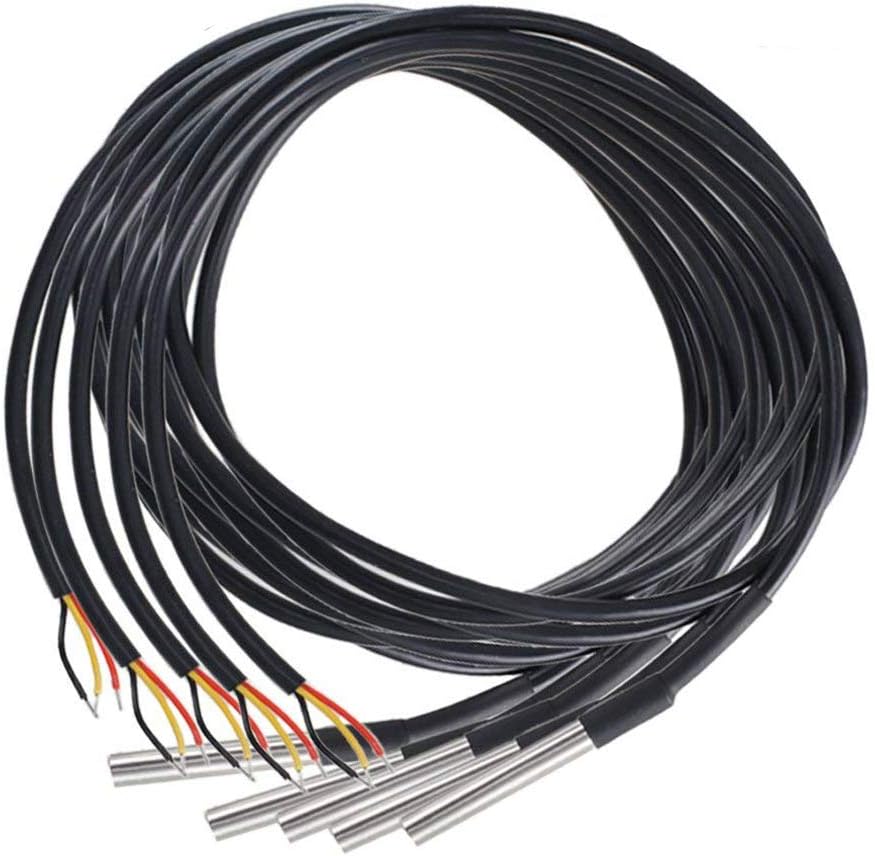
This bulk pack provides five robust sensors ideal for projects needing extensive spatial coverage or redundancy in critical systems. The stainless steel casing adds durability and protection against corrosion.
We may earn a commission when you buy through this link, at no additional cost to you.
With a wide temperature range it is suitable for industrial applications where conditions might swing from freezing to boiling water temperatures.
Users should note that resistors are not included so planning for component acquisition is necessary before starting the wiring process.
For builders needing multiple probes for a large system this option offers a great balance of durability and affordability per unit.
Stainless steel enclosures protect the internal components from harsh chemicals and physical damage during use.
Five units allow covering large areas with multiple data points for comprehensive thermal mapping.
We may earn a commission when you buy through this link, at no additional cost to you.
Selecting the right sensor requires understanding your project requirements and the limitations of your microcontroller platform.
Accuracy refers to how close the reading is to the true value while precision is how consistent repeated readings are. Look for sensors with specific tolerance values such as plus or minus zero point five degrees Celsius.
For critical applications like incubators or industrial controls choose sensors with tighter tolerances to ensure safety and reliability.
Verify the sensor covers the environment you intend to monitor. Some modules are limited to zero to fifty degrees while others work from negative fifty five to one hundred twenty five degrees Celsius.
Always choose a range that exceeds your expected operating conditions by a safe margin to prevent damage or errors.
Different sensors use various communication methods like I2C one wire or single wire digital signals. I2C allows multiple sensors on two wires but uses pins.
One wire sensors save pins but require careful timing and pull up resistors. Choose the protocol that fits your microcontroller capabilities and pin constraints.
If your project involves liquids or outdoor exposure waterproof probes are essential. Stainless steel or sealed probes resist corrosion and physical damage better than bare sensors.
Consider the physical casing and sealing methods to ensure the sensor survives the specific environmental conditions it will face.
Battery powered projects require sensors with low power draw. Check the voltage requirements and idle power consumption to ensure your battery lasts long enough.
Some sensors enter low power modes automatically but others may need software intervention to conserve energy effectively.
Many sensors combine temperature and humidity which saves space and wiring compared to buying two separate devices. Ensure the humidity range and accuracy meet your needs.
If you only need temperature buying a dedicated temperature sensor might be cheaper and more accurate than a combined unit.
Modules with built-in pull up resistors or adapter boards simplify connection and reduce soldering needs. Look for clear pin labeling like VCC GND and DATA.
Simpler wiring reduces assembly time and the risk of accidental short circuits during the setup process.
Consider the total cost including any required resistors or adapter boards. Buying packs is often cheaper per unit if you need multiple sensors.
Ensure the sensor is readily available to avoid project delays if you need to replace or expand your system.
Install the sensor securely in a location where it can reach the environment you want to monitor without obstruction. Avoid direct sunlight or heat sources from electronics nearby.
Connect the wiring exactly as the pinout diagram suggests with special attention to data lines that require pull up resistors to function correctly.
Update the sensor software library periodically to ensure compatibility and bug fixes that might improve reading stability and performance.
Connect the red wire to VCC black to GND and yellow to a digital pin. Place a 4.7K resistor between the data and VCC lines to ensure stable communication.
Yes sensors using one wire protocols like DS18B20 can be daisy chained on a single pin as long as each has a unique address and the bus is properly pulled up.
DHT22 offers higher accuracy wider temperature range and full humidity coverage compared to DHT11 but it is slightly more expensive and slower to read.
Most I2C sensors have internal pull up resistors but if readings are unstable adding external 4.7K resistors on SDA and SCL lines may help stabilize the signal.
Accuracy varies from plus or minus two degrees for basic units to plus or minus zero point three degrees for precision models. Check the specs for specific tolerance values.
Only sensors with stainless steel or sealed probes are waterproof. Standard modules like DHT11 are not waterproof and should be kept dry to avoid damage.
Most sensors listed support 3.3 to 5.5 volts which makes them compatible with 3.3V logic boards like ESP32 and some Arduino variants without extra voltage level shifters.
Use libraries like OneWire DallasTemperature for DS18B20 and DHT sensor library for DHT modules. They are free and available via the Arduino library manager.
We reviewed ten top options ranging from budget friendly modules to robust waterproof probes. Each sensor offers distinct advantages depending on your specific monitoring needs.
Prioritize accuracy and durability if your project operates in harsh conditions while cost and ease of use matter most for educational or indoor tasks.
Check current prices and stock levels before purchasing as availability can fluctuate. This guide will help you find a reliable sensor for any project.